
8 min read · Last updated September 29, 2026
- Self-employment tax adds a 15.3% bill on top of income tax for 1099 contractors, a cost a W-2 employer normally splits with the worker.
- The average employer paid $7,885 a year toward single-coverage health insurance in 2025, money a 1099 contract never includes.
- The average 401(k) employer match is worth 4.6% of pay, requiring about a 6.5% employee deferral to capture in full (Vanguard, 2025).
- In this comparison, a $128,960 1099 contract and a $105,000 W-2 salary land within about $450 of each other in take-home value once those costs are counted.
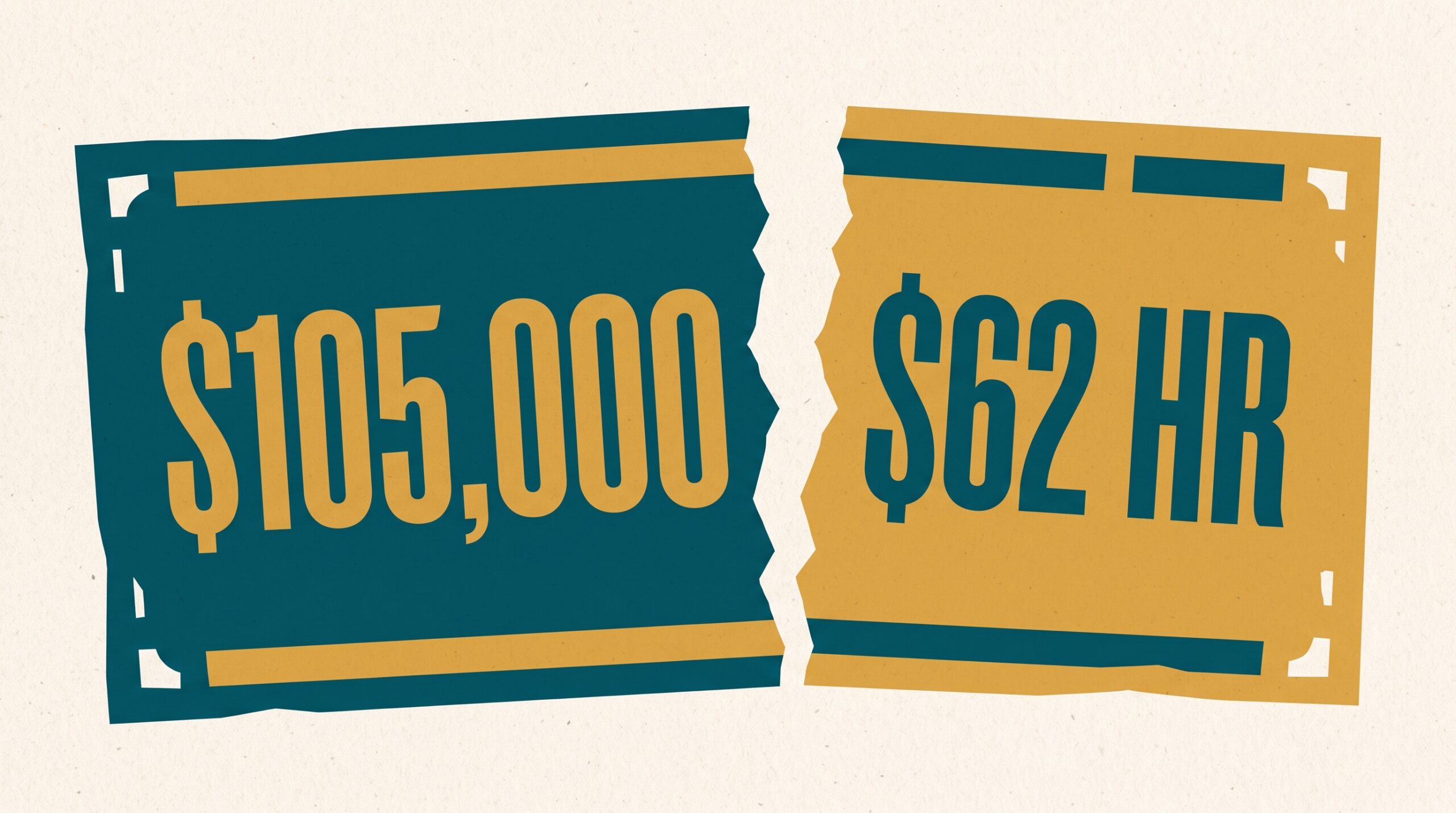
For this comparison, a $128,960 1099 contract and a $105,000 W-2 salary land within about $450 of each other in real take-home value once a 15.3% self-employment tax and the W-2 job’s employer-paid health insurance and 401(k) match are counted. The bigger hourly number is not automatically the bigger real number.
In this article
- What a $105,000 W-2 Salary Actually Pays
- What a $62-an-Hour 1099 Contract Actually Pays
- What a Contract-to-Hire Role Through a Staffing Agency Actually Pays
- Choose the W-2 Job If, the 1099 Contract If, or Contract-to-Hire If
- What Could Change the Calculus
- Frequently Asked Questions
A W-2 role paying $105,000 a year, a 1099 contract paying $62 an hour, and a contract-to-hire placement paying $58 an hour can look like three different numbers on an offer page. Once self-employment tax, health insurance, and a 401(k) match are added in, the gap between the highest offer and the lowest can shrink to a couple thousand dollars a year. The right pick depends on how each offer is taxed and what it does or does not include.
What a $105,000 W-2 Salary Actually Pays
A W-2 job is one where the employer withholds income tax and payroll tax from every paycheck and reports the year’s wages on a Form W-2 the following January. The employer also matches the Social Security and Medicare tax withheld from the paycheck. On a $105,000 salary, that 7.65% withholding comes to $8,032.50 for the year, leaving $96,967.50 in take-home pay before income tax.
Two things that number does not show. The average single-coverage health insurance premium in 2025 was $9,325, with covered workers themselves paying $1,440 of that out of pocket, according to the Kaiser Family Foundation (KFF) Employer Health Benefits Survey. That leaves the employer paying the remaining $7,885 a year toward single-coverage health insurance, a benefit a 1099 contract never includes. Vanguard’s 2025 “How America Saves” report puts the average employer 401(k) match at 4.6% of pay. Capturing it in full typically requires deferring about 6.5% of pay, per Vanguard’s How America Saves 2025 report. On $105,000, that means deferring about $6,825 to receive $4,830 in matched money.
Add it up: take-home pay ($96,967.50) plus health insurance ($7,885) plus the match ($4,830) totals $109,682.50 in combined value.
What a $62-an-Hour 1099 Contract Actually Pays
A 1099 form is what a business sends a self-employed worker at year’s end instead of a W-2. It means no tax was withheld during the year, and the worker owes income tax and the full payroll tax bill directly. At $62 an hour over a standard 2,080-hour work year (40 hours a week, 52 weeks, no built-in paid time off), gross pay is $128,960. That is nearly $24,000 more than the salaried offer.
A 1099 worker owes self-employment tax on net self-employment earnings. That tax is a combined 15.3% rate, 12.4% for Social Security and 2.9% for Medicare, confirmed on the IRS (Internal Revenue Service) self-employment tax page. Assuming no significant deductible expenses, that is $19,730.88 in self-employment tax, leaving $109,229.12 in take-home pay before income tax. The IRS lets a contractor deduct half that tax from adjusted gross income, though it lowers taxable income only, not the tax itself.
That $109,229.12 sits only about $453 below the W-2 job’s combined take-home pay and benefits value of $109,682.50, despite nearly $24,000 more in gross pay. The contract also carries no employer-paid health insurance and no 401(k) match. Replacing just the $7,885 health insurance value erases most of what the higher rate appeared to buy.
What a Contract-to-Hire Role Through a Staffing Agency Actually Pays
Contract-to-hire means a staffing agency, not the client company, is the worker’s actual employer during the contract, typically three to six months before a conversion decision. Pay runs through a normal W-2, so the payroll tax share is 7.65%, not the 15.3% self-employment hit of a 1099 contract. At $58 an hour over the same 2,080-hour year, gross pay is $120,640. The 7.65% withholding comes to $9,228.96, leaving $111,411.04 in take-home pay before income tax, the highest of the three.
The catch is benefits. Many staffing agencies withhold health insurance and a 401(k) match until conversion, and some never add a match at all. This offer’s higher take-home often means zero benefit value during the contract, and whatever arrives at conversion, if it happens, decides whether this path pays off.

| Factor | W-2 Salaried ($105,000/yr) | 1099 Contract ($62/hr) | Contract-to-Hire ($58/hr) |
|---|---|---|---|
| Gross annual pay (2,080-hour year) | $105,000 | $128,960 | $120,640 |
| Payroll or self-employment tax | $8,032.50 (7.65%) | $19,730.88 (15.3%) | $9,228.96 (7.65%) |
| Take-home before income tax | $96,967.50 | $109,229.12 | $111,411.04 |
| Employer health insurance value | $7,885/yr average (KFF, 2025) | $0, self-purchased | Typically $0 until conversion |
| 401(k) match available | Up to $4,830/yr (4.6% average, Vanguard 2025) | None | Typically none until conversion |
| Best for | Workers who want predictable pay and built-in benefits | Workers whose rate clears the tax and benefits gap and who have coverage elsewhere | Workers targeting a permanent role who can absorb a benefits gap short term |
Choose the W-2 Job If, the 1099 Contract If, or Contract-to-Hire If
Choose the W-2 job if predictable pay, employer-paid health insurance, and a 401(k) match matter more than the biggest gross number on the page. The $105,000 salary here delivers about $109,682.50 in combined take-home pay and benefit value, competitive with both hourly offers once their real costs are counted.
Choose the 1099 contract if the rate is high enough to absorb the 15.3% self-employment tax. Health insurance should already be covered through a spouse, a marketplace plan, or another source. At $62 an hour, this contract’s after-tax value falls only slightly short of the salaried job’s combined total, so a lower rate would likely fall well short.
Choose contract-to-hire if landing a permanent role at the client company is the real goal, and a stretch without employer health insurance or a match is affordable. The $58-an-hour rate produces the highest take-home number of the three, but only during the contract phase, before any conversion terms are known.
What Could Change the Calculus
State income tax rates vary widely and were left out of this comparison; a no-income-tax state stretches any of these three offers further than a high-tax state does. A reader who already has health insurance through a spouse’s employer removes the single biggest cost gap facing the 1099 and contract-to-hire paths. The flexibility of choosing projects and setting a schedule in 1099 work, and the odds that a contract-to-hire role ever converts, are both real factors no dollar figure here captures.
Readers weighing how to get into a role in the first place, rather than which offer to accept once hired, may find our comparison of workforce training paths into a career useful.
Frequently asked questions
Should I ask for a higher hourly rate on a 1099 contract to make up for self-employment tax? Yes. A 1099 rate needs to clear the 15.3% self-employment tax plus the value of any health insurance and retirement match a comparable W-2 job would include. It should not just look bigger than the salaried number on paper.
How much more should a 1099 rate be compared to an equivalent W-2 salary? There is no fixed rule, but this comparison shows why higher is not automatically better. A contract paying 23% more in gross pay than a salary still ended up about $453 behind in combined take-home and benefits value once self-employment tax and lost benefits were counted.
Does contract-to-hire pay less than a direct W-2 job? Not necessarily in take-home pay, since it runs through standard payroll withholding rather than self-employment tax. The tradeoff is usually benefits, since many staffing agencies delay health insurance and a 401(k) match until after conversion to a permanent role.
Can I negotiate benefits into a 1099 contract? Contractors cannot receive a W-2 employer’s health insurance or 401(k) match by definition, since those are payroll benefits tied to employee status, not contractor status. What a contractor can negotiate is a higher hourly rate built specifically to cover a self-purchased health plan and their own retirement contributions.
What happens to my pay if a contract-to-hire role does not convert to permanent? Pay and any temporary benefits from the staffing agency simply end when the contract ends, unless the agency has other placements available. The permanent salary and benefits at conversion are never guaranteed until the client company makes that offer in writing, so it is worth asking about conversion odds upfront.
No responses yet